Checked against official state laws and government sources. Laws and fines change, so confirm with the sources listed at the end.
Minnesota has no single school zone speed limit. Under Minn. Stat. § 169.14, subd. 5a, a city or county sets each school zone after a traffic study, and the limit can be no lower than 15 mph and no more than 30 mph below the normal limit. Speeding in a school zone adds a surcharge equal to the fine, so the ticket costs about twice as much, and since 2025 Minneapolis and Mendota Heights have used speed cameras near schools.
Key facts
- School zone limits are set locally under § 169.14, subd. 5a, with a floor of 15 mph and a maximum cut of 30 mph below the normal limit. On trunk highways, MnDOT must agree.
- The reduced limit applies when children are present going to or leaving school, or during recess, and only where signs mark both ends of the zone.
- A school zone speeding conviction adds a surcharge equal to the fine, never less than $25, on top of the base fine and the $75 state court surcharge.
- A state pilot lets Minneapolis and Mendota Heights run speed cameras within 2,000 feet of a school through July 31, 2029. Camera tickets are $40, or $80 at 20 mph or more over.
- Minnesota's hands free law, § 169.475, bans holding a phone while driving everywhere in the state, not just in school zones.
- Passing a stopped school bus with its red lights flashing is a misdemeanor with a fine of at least $500.
Minnesota school zone speed limit
The rule lives in Minnesota Statutes § 169.14, subdivision 5a. It lets local authorities set a school speed limit within a school zone of a public or nonpublic school, based on an engineering and traffic investigation done the way the commissioner of transportation prescribes. If the road is a trunk highway, the commissioner must consent.
The statute puts two limits on how low the number can go. A school speed limit cannot be lower than 15 mph, and it cannot be more than 30 mph below the limit that normally applies on that road. So a street normally posted at 30 mph could get a school limit as low as 15 mph, while a 55 mph highway could go no lower than 25 mph.
A December 2023 Minnesota House Research summary of state speed limits describes the same rule: a local road authority may, based on its own engineering and traffic study, set a school zone limit as low as 15 mph and no more than 30 mph below the surrounding limit. So limits differ from town to town; the number on the sign is the one that counts.
What counts as a school zone
Subdivision 5a defines a school zone as the part of a street or highway that abuts school grounds where children have access to the road from the school property, or where an established school crossing is located. The school advance sign required by the state traffic control manual must be in place. That definition matters because the school limit and its surcharge apply only inside that marked stretch.
The basic speed rule still applies on top of the posted number. Subdivision 1 bars driving faster than is reasonable and prudent under the conditions and makes every driver responsible for staying aware of actual and potential hazards. Children crossing near a school are exactly that kind of hazard, so you can be cited for going too fast even below the posted school limit.
For limits in other states, see our table of school zone speed limits by state.
Minnesota school zone hours
Minnesota does not set a statewide clock. Under subdivision 5a, a school speed limit is in effect when children are present, going to or leaving school during opening or closing hours, or during school recess periods. Outside those times the regular limit applies.
The limit also depends on signs. The statute says a school speed limit is effective once signs showing the speed and marking the beginning and end of the reduced zone are erected, and from then on any speed above the posted school limit is unlawful. If a zone is missing the sign at one end, that is a real legal issue, not a technicality.
Treat the start and end of the school day as active time. Our guide to school zone hours explains how other states handle times, flashing beacons and summer.
How much is a school zone ticket in Minnesota?
A Minnesota speeding ticket is usually a petty misdemeanor. The total has several parts, and the school zone part is set by statute.
- The base fine. Fines for payable offenses come from a statewide schedule approved each year by the Minnesota Judicial Council. House Research reports that the speeding base fine normally ranges from $40 to $150, depending on speed.
- The school zone surcharge. Under subdivision 5a(d), a person who violates a school speed limit is assessed an additional surcharge equal to the fine imposed, but not less than $25. In effect, the fine doubles.
- The state court surcharge. Minn. Stat. § 357.021, subd. 6 adds a $75 surcharge to every conviction, including petty misdemeanors where a fine is imposed. A county law library fee may also be added.
Subdivision 2 of the same statute adds a similar surcharge, equal to the fine and at least $25, for driving 20 mph or more over the limit anywhere. A driver going 40 mph in a 20 mph school zone is exactly 20 mph over, so expect a large ticket and possibly a court appearance.
| Part of the ticket | Amount | Source |
|---|---|---|
| Base speeding fine | Normally $40 to $150, set by the statewide payables list | House Research, Minnesota Speed Limits (2023) |
| School zone surcharge | Equal to the fine, at least $25 | § 169.14, subd. 5a(d) |
| Surcharge for 20 mph or more over | Equal to the fine, at least $25 | § 169.14, subd. 2 |
| State court surcharge | $75 | § 357.021, subd. 6 |
| Law library fee | Varies by county | House Research |
Even at the bottom of the range, the math adds up fast. A $40 base fine plus a $40 school zone surcharge plus the $75 state surcharge is $155 before any law library fee. The exact amount for your speed is on your citation or the court's payables list, and a judge can set a different amount if you go to court. Our national guide to school zone ticket costs compares Minnesota with other states.
Points, your driving record and suspension
Minnesota does not use a point system. House Research explains that instead, habitual traffic violations, including speeding, can cost you your driving privileges. Under Minn. Stat. § 171.18, the Department of Public Safety may suspend the license of a driver who is a habitually reckless or negligent driver or a habitual violator of the traffic laws.
School zone tickets do land on your record. Minnesota leaves some minor speeding tickets off the driving record, but only on roads posted at 55 or 60 mph and only for small overages. House Research notes that violations are still recorded when the posted limit is below 55 mph, which covers essentially every school zone. Insurers can see recorded convictions when they set rates.
Are there speed cameras in Minnesota school zones?
Yes, in two cities. The Legislature approved a traffic safety camera pilot in 2024, and camera enforcement began under Minn. Stat. § 169.147 on August 1, 2025. The section lets MnDOT use speed cameras in trunk highway work zones, and lets two cities, Minneapolis and Mendota Heights, run local programs. The pilot expires July 31, 2029.
Local cameras must go in trunk highway work zones or within 2,000 feet of a school, school zone or college with an identified traffic safety concern. Signs must warn drivers before each camera site and show the speed limit. A camera ticket can only be issued if the driver was going at least 10 mph over the limit, the violation came at least 30 days after the camera started, and a traffic enforcement agent reviewed the images.
What a camera ticket costs
Camera tickets are handled under § 169.14, subd. 13. The vehicle owner is guilty of a petty misdemeanor with a fine of $40, or $80 if the speed was at least 20 mph over the limit. A first violation gets a warning with no fine. A second violation is eligible for diversion, including a traffic safety course that avoids the fine and conviction. Commercial vehicles and commercial license holders do not get the warning or diversion. FOX 9 reported that camera citations do not go on a driver's record unless the driver holds a commercial license.
Where the cameras are
Minneapolis switched on its first cameras on October 1, 2025, at five locations that all sit within 2,000 feet of a school, according to the city's traffic safety camera pilot page. The sites are on Fremont Avenue North near West Broadway, 18th Avenue NE near Central Avenue, 3rd Street North near 1st Avenue North, Chicago Avenue South near Franklin Avenue and Nicollet Avenue South near 46th Street. In September 2026, FOX 9 reported eight cameras at those five sites, a 69% drop in drivers going 20 mph or more over, and a city proposal for up to 11 more cameras.
Mendota Heights runs one camera on the 1300 block of Delaware Avenue, watching southbound traffic about 1,877 feet from Somerset Elementary School, according to the city's speed safety camera page. The camera triggers at 10 mph or more over the limit. The West St. Paul Reader reported that the camera finished its warning period and citations began August 21, 2026.
Bills in the 2026 session would have extended camera authority to other cities and removed the 2029 end date, but the statute still names only Minneapolis and Mendota Heights. For how other states use cameras near schools, see our school zone speed cameras guide.
Minnesota school zone phone law
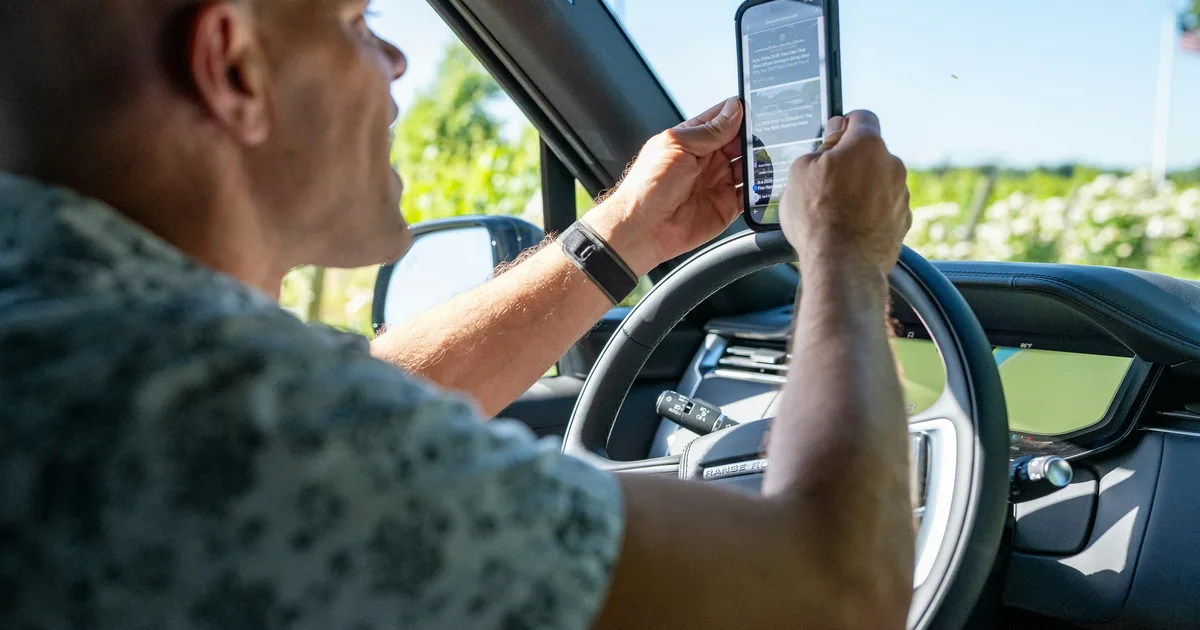
Minnesota does not have a separate phone rule for school zones because its hands free law already covers every road. Under Minn. Stat. § 169.475, while a vehicle is in motion or part of traffic, a driver may not hold a phone with one or both hands. The driver also may not use it to read or send messages, make calls including video calls, or watch video, play games or use apps.
The law allows voice or hands free use with a single touch or voice command, GPS navigation and audio that do not require typing or holding the phone, and calls for emergency help. Reading messages, video calling, live streaming and gaming are not allowed even in hands free mode. The statute treats a car as part of traffic unless it is lawfully stopped somewhere not used for travel and not blocking traffic, so waiting at a red light still counts. Put the phone down until you are parked.
The law took effect August 1, 2019, according to the Department of Public Safety. The statute sets a $275 fine for a second or later violation. The Office of Traffic Safety says a first ticket costs $100 or more including court fees, and later tickets $300 or more. Injuring or killing someone while breaking the law can lead to a felony charge. For other states, read our guide to phone use in school zones.
Passing a stopped school bus
Under Minn. Stat. § 169.444, a driver approaching a school bus that is stopped with its red lights flashing must stop at least 20 feet away and stay stopped until the lights stop flashing. Flashing amber lights mean the bus is about to stop, and you may not pass on the right side, where children get on and off, while the amber lights are flashing.
- Failing to stop, or passing on the right, is a misdemeanor with a fine of not less than $500.
- Passing on the door side or while a child is outside the bus on the road or sidewalk, after failing to stop, is a gross misdemeanor.
- The vehicle owner can be charged with a petty misdemeanor when the driver is not identified, unless the vehicle was stolen or someone else is convicted.
- A second conviction within five years is grounds for license suspension under § 171.18.
Drivers on the other side of a road divided by a barrier or a raised or depressed median do not have to stop.
Paying or contesting a Minnesota ticket
Most payable tickets go through the Minnesota Court Payment Center. Benton County's court payment page explains the usual options: pay by check or money order to the Minnesota Court Payment Center, pay by credit card online or by phone, or pay in person at the courthouse. Paying ends the case, and a school zone speeding conviction is recorded on your driving record.
To plead not guilty or explain the circumstances, you need to appear in court. If you neither pay nor appear by the date on the ticket, a petty misdemeanor is treated as an admission of guilt and you give up your right to a trial. Many courts also offer a meeting with a hearing officer, who can discuss options before a court date.
Minnesota has no general traffic school that erases a school zone speeding ticket. The diversion option in subdivision 13 applies only to camera tickets. Some prosecutors offer local diversion programs, so ask the court or city attorney named on your citation.
Since Minnesota school zones are tied to children being present and enforced by officers and cameras, it pays to know where they are before you reach them. An app like SchoolSlow can alert you as you approach a school zone, including the camera corridors in Minneapolis and Mendota Heights, so you are slowing down before the sign comes into view.
Frequently asked questions
What is the school zone speed limit in Minnesota?
There is no single statewide number. Under Minn. Stat. § 169.14, subd. 5a, local authorities set each school limit after a traffic study, and it cannot be lower than 15 mph or more than 30 mph below the normal limit. Always obey the number on the sign.
How much is a school zone speeding ticket in Minnesota?
It depends on your speed. The base speeding fine normally runs $40 to $150, the school zone surcharge adds an amount equal to the fine (at least $25), and every conviction adds a $75 state surcharge. Even the smallest ticket comes to about $155 plus any law library fee.
Are school zone fines doubled in Minnesota?
Effectively, yes. Section 169.14, subd. 5a(d) adds a surcharge equal to the fine imposed, with a minimum of $25, for violating a school speed limit. Going 20 mph or more over the limit triggers a similar surcharge under subdivision 2.
When do Minnesota school zone speed limits apply?
The reduced limit applies when children are present going to or leaving school during opening or closing hours, or during recess. The zone must have signs marking its start and end and showing the speed.
Does Minnesota have speed cameras in school zones?
Yes, in Minneapolis and Mendota Heights under a pilot in § 169.147 that runs through July 31, 2029. Cameras must be within 2,000 feet of a school or in a highway work zone. The first violation is a warning, and later tickets are $40, or $80 at 20 mph or more over.
Can I use my phone in a Minnesota school zone?
Only hands free. Minnesota's hands free law bans holding a phone while driving anywhere in the state, including while stopped in traffic. Voice commands, navigation and audio are allowed if you do not hold the phone.
Does a school zone ticket go on my Minnesota driving record?
Yes, if it comes from an officer. Minnesota skips the record only for small overages on 55 and 60 mph roads. Camera tickets are different and do not go on the record unless the driver holds a commercial license.
Does Minnesota use points on a driver's license?
No. Minnesota has no point system. Instead, the state can suspend the license of a habitual violator of the traffic laws or a habitually reckless or negligent driver under § 171.18.
Sources
- Minnesota Statutes § 169.14, Speed Limits, Minnesota Office of the Revisor of Statutes, accessed November 2026.
- Minnesota Speed Limits, Minnesota House Research Department, December 2023, accessed November 2026.
- Minnesota Statutes § 357.021, Court Administrators; Fees, Minnesota Office of the Revisor of Statutes, accessed November 2026.
- Minnesota Statutes § 171.18, Suspension, Minnesota Office of the Revisor of Statutes, accessed November 2026.
- Minnesota Statutes § 169.147, Traffic Safety Camera Systems, Minnesota Office of the Revisor of Statutes, accessed November 2026.
- Minneapolis may add 11 more traffic cameras after data shows steep drop in speeding, FOX 9, September 3, 2026, accessed November 2026.
- Traffic safety camera pilot, City of Minneapolis, accessed November 2026.
- Speed Safety Camera Program, City of Mendota Heights, accessed November 2026.
- Speed camera on Delaware Avenue, West St. Paul Reader, August 19, 2026, accessed November 2026.
- Minnesota Statutes § 169.475, Use of Wireless Communications Device, Minnesota Office of the Revisor of Statutes, accessed November 2026.
- Hands free becomes law, Minnesota Department of Public Safety, Office of Traffic Safety, accessed November 2026.
- Nothing on a phone is worth a life: Commit now to driving distracted free, Minnesota Department of Public Safety, March 28, 2025, accessed November 2026.
- Minnesota Statutes § 169.444, School Bus; Stopping and Passing, Minnesota Office of the Revisor of Statutes, accessed November 2026.
- Paying Fines, Benton County, Minnesota, accessed November 2026.