Checked against official state laws and government sources. Laws and fines change, so confirm with the sources listed at the end.
There is no single national answer to what time school zones start and end. The reduced speed limit applies during the hours shown on the sign, while the attached beacon is flashing, or "when children are present," and most zones are active for roughly 30 to 90 minutes around the morning bell and again around dismissal on school days. If the sign gives no times and has no lights, assume the lower limit applies whenever children could be around.
Key facts
- School zones are switched on in three ways: posted times on a plaque, a flashing yellow beacon, or a "when children are present" plaque.
- Typical windows run from about 30 to 45 minutes before the first bell until classes start, and from dismissal until about 30 minutes after.
- Florida law limits the reduced speed to 30 minutes before, during and 30 minutes after student arrival and dismissal periods (Fla. Stat. § 316.1895).
- Many states turn zones off on days school is not in session, but summer school, breakfast programs and year round schools can keep them active.
- A sign with no time limit at all means the lower speed applies at all times.
How school zones are activated
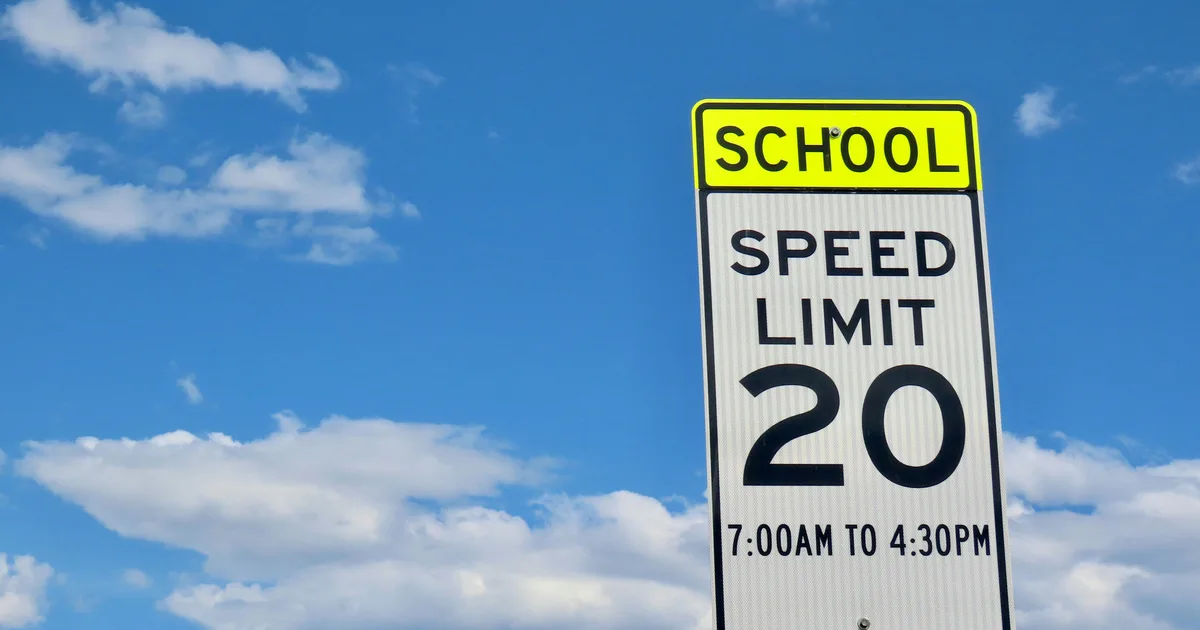
The federal Manual on Uniform Traffic Control Devices (MUTCD), published by the Federal Highway Administration, sets the sign rules that every state adopts, sometimes with a state supplement. Section 7B.05 of the 11th Edition says a static School Speed Limit assembly has three parts: a SCHOOL plaque on top, a speed limit sign in the middle, and a bottom plaque "indicating the specific periods of the day and/or days of the week that the special school speed limit is in effect."
That bottom plaque is the key to reading any school zone. The MUTCD allows four kinds, and each one tells you when to slow down in a different way.
1. Posted times (S4-1P and S4-6P plaques)
A time of day plaque lists the hours, for example 7:15 to 8:15 in the morning and 2:30 to 3:30 in the afternoon. A days of week plaque, usually Monday through Friday, can be added. These are the easiest zones to obey: if the clock is inside the window on a listed day, the lower limit applies.
2. Flashing beacons (S4-4P plaque or S5-1 sign)
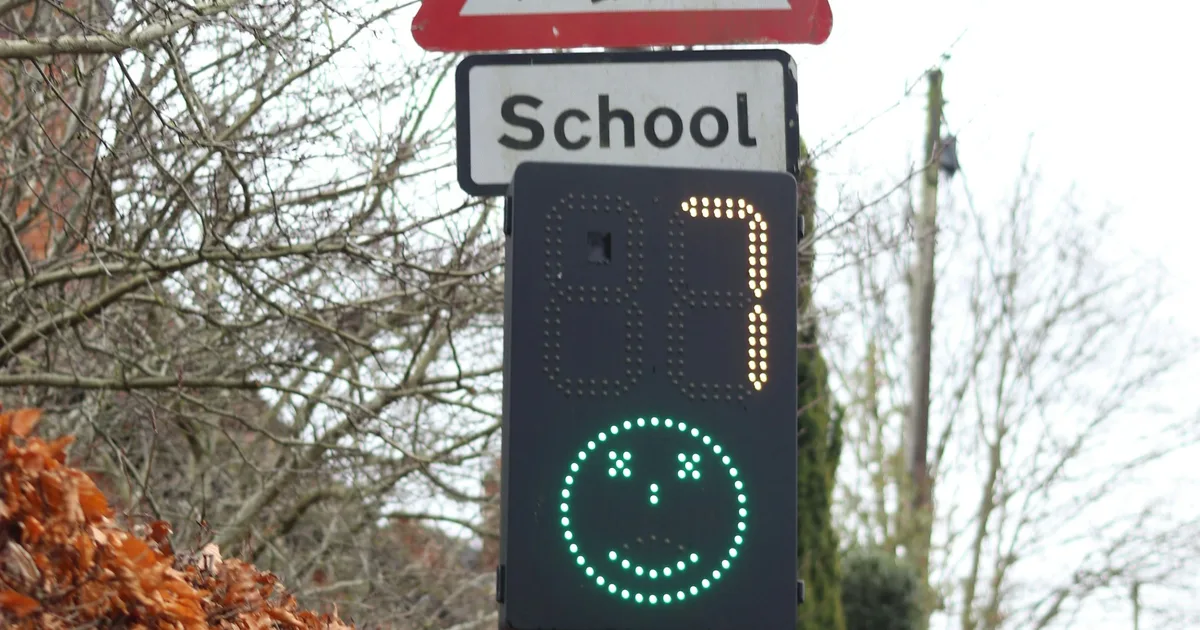
A "WHEN FLASHING" plaque, or the combined "School Speed Limit XX When Flashing" sign, is paired with yellow lights. The MUTCD requires a Speed Limit Sign Beacon "to identify the periods that the school speed limit is in effect." Lights flashing means the school limit applies. Lights dark means the normal limit applies.
3. "When children are present" (S4-2P plaque)
This plaque has no clock attached. The lower limit applies whenever children are present, and what counts as "present" depends on state law. It is the most open to interpretation, and that is covered in its own section below.
4. No time limit at all
If a school speed limit sign has no bottom plaque and no beacon, treat it as active at all times. The MUTCD also offers an "ALL YEAR" plaque (S4-7P) for a school that "operates on a 12 month schedule," which warns you that summer is not a break at that location.
What time do school zones start and end?
Most school zones are active twice a day: once for arrival and once for dismissal. A few states and cities add a lunch window. The exact times follow each school's bell schedule, so two zones on the same road can have different hours.
Morning window
Texas guidance for state highways, in 43 Texas Administrative Code § 25.22, recommends that school zones be in effect "from approximately 45 minutes before school opens until classes begin." Seattle's transportation department runs its beacons from 40 minutes before the first bell until 10 minutes after it, a total of 50 minutes, because breakfast is served 25 minutes before class. For private schools without breakfast, Seattle starts at 30 minutes before the bell.
Afternoon window
The same Texas rule recommends "a 30 minute period beginning at the close of school." Seattle flashes from 10 minutes before dismissal until 30 minutes after, a total of 40 minutes.
Lunch window
Texas guidance also lists "the beginning to the end of the lunch period" as a time the zone may be in effect. This matters near high schools with open campuses, where students cross the road at midday.
A real schedule
Charlotte County, Florida publishes a flasher schedule for every school beacon. In its 2025 to 2026 schedule, many elementary school morning windows run 7:40 a.m. to 9:10 a.m., while the earliest starts at 6:10 a.m. Afternoon windows fall between 1:40 p.m. and 4:40 p.m., and the latest, at a middle school, runs 3:40 p.m. to 4:40 p.m.
For a sense of scale, a driver doing 35 mph through a zone posted at 20 mph during those windows is 15 mph over, and some states, such as Washington under RCW 46.61.440, double the penalty inside a school zone. See our school zone ticket cost guide for what that can mean.
School zone hours by state: examples from the law
Some states write the hours into statute. Others leave them to engineers and local governments, who post them on signs. This table shows examples taken from state law and official guidance. Always obey the sign in front of you, because local zones can be more specific.
| State | How hours are set | When the reduced limit applies | Source |
|---|---|---|---|
| Florida | Statute, with posted times or beacons | 30 minutes before, during and 30 minutes after periods when students arrive for breakfast programs or school sessions and leave school sessions | Fla. Stat. § 316.1895(5) and (6) |
| Texas | Local ordinance or state order; guidance for intervals | Recommended: about 45 minutes before school until classes begin, the lunch period, and 30 minutes after close of school | 43 Tex. Admin. Code § 25.22(d) |
| California | Statute | 25 mph near a school posted with a SCHOOL sign "while children are going to or leaving the school either during school hours or during the noon recess period," and near unfenced grounds while children use them | Cal. Veh. Code § 22352(b)(2) |
| Illinois | Statute | 20 mph on school days when children are present and close enough to traffic to create a hazard; the statute defines the school day as 6:30 a.m. to 4 p.m. | 625 ILCS 5/11-605 |
| Oregon | Statute | 20 mph while the beacon flashes; if there is no beacon, 7 a.m. to 5 p.m. on days school is in session; at school crosswalks, when children are present | ORS 811.111, 811.124, 810.243 |
| Nevada | Statute plus local designation | 15 mph in school zones, but not on a day school is not in session, not during class hours when the beacon is dark, and not when the sign shows the limit is not in effect | NRS 484B.363 |
| Pennsylvania | Statute; PennDOT approves hours | 15 mph in school zones established under PennDOT regulations; PennDOT must approve each zone's location and hours of operation | 75 Pa.C.S. § 3365(b) |
| Washington (Seattle) | City policy | 20 mph; beacons flash 40 minutes before to 10 minutes after the start bell and 10 minutes before to 30 minutes after dismissal | Seattle DOT beacon policy, 2026 |
For the speed limits themselves in every state, see our school zone speed limits by state guide.
What "when children are present" means
"When children are present" is the plaque drivers argue about most. The MUTCD lists the plaque but does not define the phrase, so each state's law decides. Here are three real definitions.
Oregon: children in or waiting at the crosswalk
Oregon is unusually specific. Under ORS 811.124, children are present at a school crosswalk "at any time and on any day" when children are in the crosswalk, children are waiting on the curb or shoulder at the crosswalk, or a school traffic patrol member is there to help them cross. Notice the words "any time and on any day": a crosswalk zone in Oregon can apply on a Saturday if a child is waiting to cross.
Illinois: close enough to create a hazard
Illinois law applies its 20 mph school limit on school days when children are present and close enough to motor traffic that a potential hazard exists. A child on the far side of a fenced playground may not trigger the limit. A child walking on the sidewalk next to the road almost certainly does.
California: going to or leaving school
California's Vehicle Code § 22352 ties its 25 mph school limit to children "going to or leaving the school either during school hours or during the noon recess period." It separately covers school grounds not separated from the road by a fence, gate or other barrier, where the limit applies while the grounds are in use by children.
The practical rule is the same everywhere. If you can see children on the sidewalk, at the crosswalk, at a bus stop or on unfenced grounds next to the road, slow to the school limit. A ticketing officer only needs to show children were present, and you will not win an argument about how close they were.
Are school zones active in summer, on holidays and on weekends?
Usually not, but it depends on how the zone is activated and on state law. Here is how to think about each case.
Holidays and teacher workdays
Several states tie the reduced limit to days school is actually in session. Nevada's NRS 484B.363 says the 15 mph school zone limit does not apply "on a day on which school is not in session." Oregon's rule for zones without beacons applies only "on a day when school is in session." Florida's statute ties the window to scheduled breakfast programs and school sessions. On a district holiday, these zones are off.
There is a catch. A zone with fixed posted times, for example "7:00 to 8:30 AM school days," relies on you knowing the school calendar. If you are not sure school is out, slow down. Beacons are easier because the city usually programs them around the district calendar.
Weekends
Zones with posted times often carry a days of week plaque, which settles the question. Beacon zones are normally dark on weekends. The main exceptions are "when children are present" zones and zones with no time limit, which apply any day of the week.
Summer school
Summer school can switch zones back on. Seattle's 2026 beacon policy says the city operates beacons for elementary summer learning programs at Seattle Public Schools locations, and as of 2026 also for middle and high school summer programs. Florida's statute ties the window to regularly scheduled school sessions, so a zone serving a summer session may be active in July.
Year round schools
Look for the MUTCD "ALL YEAR" plaque under the SCHOOL sign. It means the school runs on a 12 month calendar and you should expect the zone to be active in summer.
School zone flashing lights: what they mean
Yellow flashing lights on a school speed limit sign mean the school limit is in effect right now. When the lights are off, the regular posted limit applies, unless the sign also has a "when children are present" plaque and children are there.
Beacons are usually run by a time clock or a central computer that the city or county programs with each school's bell times. Florida's statute allows beacons "activated by a time clock, or other automatic device, or manually activated." Oregon's ORS 810.243 says a school zone beacon may operate "only at times when children are scheduled to arrive at or leave the school," with a narrow exception for some schools across 45 mph roads from their parking lots.
Can a beacon be wrong? Yes. Clocks drift, power fails and schedules change mid year. If a beacon is flashing at a time that seems odd, slow down anyway. If a beacon is dark while children are clearly arriving, slow down too.
Speed camera zones use the same windows
Where school zone speed cameras are legal, they generally follow the same school day windows or a fixed span close to them. Georgia's HB 651, effective July 1, 2026, allows camera enforcement only on school days during class time plus one hour before and one hour after. Maryland's law lets school zone cameras run Monday through Friday from 6:00 a.m. to 8:00 p.m. Our school zone speed cameras guide covers those rules in detail.
Practical tips for drivers
- Read the bottom plaque. Times, "WHEN FLASHING," "WHEN CHILDREN ARE PRESENT" or nothing at all each mean something different.
- Slow before the sign, not after. The limit begins at the School Speed Limit sign. Braking from 45 mph to 20 mph takes distance, so ease off when you see the yellow green SCHOOL warning sign ahead of it.
- Stay slow until the END sign. Zones often extend several hundred feet past the school.
- Assume the zone is on when in doubt. A minute lost at 20 mph costs nothing. A ticket in an active zone can cost double, and some states add points.
- Watch for buses and crossing guards. A crossing guard in the road is a signal that children are present, whatever the clock says.
Zones you drive every day are easy to remember. Zones on an unfamiliar road are where drivers get caught. SchoolSlow alerts you as you approach a school zone and warns you if you are over the limit, which helps on routes you do not know well.
Frequently asked questions
What time do school zones start and end?
It depends on the school's bell schedule and the sign. A common pattern is about 30 to 45 minutes before the first bell until classes start, then from dismissal until about 30 minutes after. Texas guidance recommends 45 minutes before school until classes begin and 30 minutes after school closes, and Florida law caps the window at 30 minutes before and after arrival and dismissal periods.
Are school zones active in summer?
Usually not, unless summer school is in session or the school runs year round. Seattle, for example, runs its beacons for summer learning programs. An "ALL YEAR" plaque under the SCHOOL sign means you should expect the zone to be active in summer.
Do school zones apply on holidays?
In many states, no. Nevada law says the school zone limit does not apply on a day school is not in session, and Oregon's default rule for zones without beacons applies only on days school is in session. If the sign shows fixed times and you are not sure whether school is out, slow down.
Do school zones apply on weekends?
Most timed and beacon zones are off on weekends, and many timed signs include a days of week plaque. Zones marked "when children are present" or with no time limit can apply any day if children are there or the sign gives no exception.
What does "school zone when children are present" mean?
It means the lower limit applies whenever children are near enough to the road to be at risk, and each state defines it. Oregon counts children in a school crosswalk, waiting at the curb or shoulder, or a school traffic patrol member at the crosswalk. Illinois looks at whether children are close enough to traffic that a potential hazard exists.
What do flashing lights on a school zone sign mean?
They mean the school speed limit is in effect right now. The MUTCD requires a beacon on any "WHEN FLASHING" school speed sign to show when the reduced limit applies. When the lights are dark, the normal limit applies unless another plaque says otherwise.
What if the school zone sign has no times listed?
If there is no time plaque, no beacon and no "when children are present" plaque, treat the school limit as active at all times. That is the safest reading.
Can I get a ticket if the school zone lights were not flashing?
In a beacon controlled zone, the school limit generally applies only while the lights flash. You can still be ticketed for exceeding the regular limit, and in a zone that also says "when children are present," children on the roadside can make the lower limit apply.
Sources
- Florida Statutes § 316.1895, Establishment of school speed zones, enforcement; designation, Florida Legislature, accessed November 2026.
- Manual on Uniform Traffic Control Devices, 11th Edition, Part 7: Traffic Control for School Areas, Federal Highway Administration, accessed November 2026.
- 43 Tex. Admin. Code § 25.22, Vehicular Traffic Control Signs, Legal Information Institute, Cornell Law School, accessed November 2026.
- Policy on School Flashing Beacon Schedules (updated spring 2026), Seattle Department of Transportation, accessed November 2026.
- School Zone Flashing Light Schedule, 2025 to 2026, Charlotte County, Florida, accessed November 2026.
- RCW 46.61.440, Maximum speed limit when passing school or playground crosswalks, Washington State Legislature, accessed November 2026.
- California Vehicle Code § 22352, Prima facie speed limits, California Public Law (text of the official code), accessed November 2026.
- 625 ILCS 5/11-605, Special speed limit while passing schools, Illinois General Assembly, accessed November 2026.
- ORS 811.111, Violating a speed limit, Oregon Public Law (text of the Oregon Revised Statutes), accessed November 2026.
- ORS 811.124, Meaning of "children are present" in ORS 811.111, Oregon Public Law, accessed November 2026.
- ORS 810.243, Operation of flashing light indicating children in school zone, Oregon Public Law, accessed November 2026.
- NRS 484B.363, School zones and school crossing zones, Nevada Legislature, accessed November 2026.
- 75 Pa.C.S. § 3365, Special speed limitations, Pennsylvania General Assembly, accessed November 2026.
- House Bill 651 (2026), as passed House and Senate, Office of the Governor of Georgia, accessed November 2026.
- Maryland Transportation Article § 21-809, Speed monitoring systems, Maryland General Assembly, accessed November 2026.