Checked against official state laws and government sources. Laws and fines change, so confirm with the sources listed at the end.
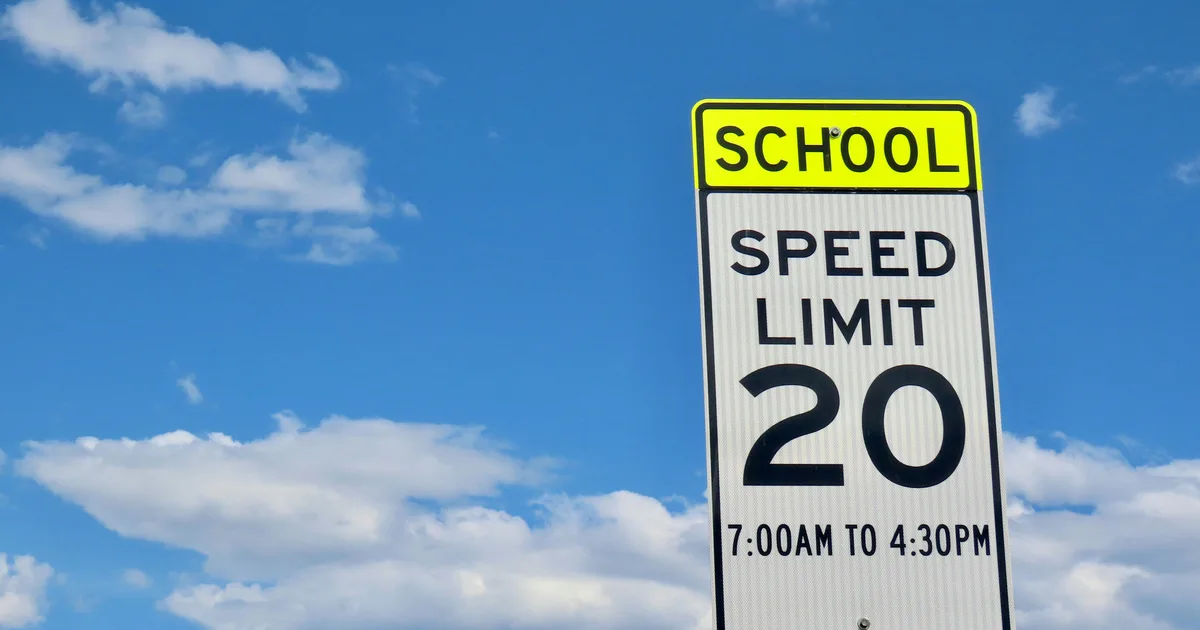
The school zone speed limit in most states is 15, 20 or 25 mph, and it usually applies only at posted times, when lights are flashing, or when children are present. About half the states write a specific number into law. The rest leave it to state or local traffic engineers, so the speed on the sign is the legal limit.
Key facts
- Statewide limits fall into three groups: 15 mph (for example Pennsylvania, Wisconsin, West Virginia and DC), 20 mph (for example Illinois, Ohio, Oregon and Washington) and 25 mph (for example New Jersey, Iowa and Virginia).
- Many states, including Texas, Georgia, Colorado and New York, set no statewide number. The posted sign controls.
- Some states set only a floor: Michigan zones cannot go below 25 mph, North Carolina and Kansas below 20 mph, and Minnesota, Montana and New York below 15 mph.
- A school zone limit usually applies only during set windows, such as school days 6:30 a.m. to 4 p.m. in Illinois or 6 a.m. to 7 p.m. in DC.
- Speeding in a school zone often means a doubled fine, extra points or a mandatory penalty that a judge cannot reduce.
What is the speed limit in a school zone?
There is no single national school zone speed limit. Each state decides, and many states hand the decision to cities, counties and the state transportation department. A 2023 research synthesis for the Minnesota Department of Transportation found that 36 of the 50 states and DC use a statute to define a school zone limit, a range, or a minimum, and that over half have a statutory limit of 15, 20 or 25 mph.
So is the school zone speed limit 15, 20 or 25? It depends on where you are driving. A driver in Pennsylvania faces 15 mph in every marked school zone. In Ohio the default is 20 mph. In New Jersey it is 25 mph. In Texas the number is whatever the city or TxDOT posted after an engineering study.
School zone speed limit by state
The table below lists each state's school zone limit, when it applies, and the law or official source behind it. "Set by posted signs" means state law sets no statewide number, so the limit is whatever the posted sign shows.
| State | School zone limit | When it applies | Law or official source |
|---|---|---|---|
| Alabama | Set by posted signs | Posted hours, or when amber lights flash | Alabama Driver Manual (ALEA) |
| Alaska | 20 mph | At a posted school or playground crosswalk, 300 feet each way | 13 AAC 02.325(d) |
| Arizona | 15 mph | In a school crossing zone between the school crossing signs | A.R.S. § 28-797 |
| Arkansas | Varies; check posted signs | Near schools during school hours when children are outside | Ark. Code § 27-51-212; Arkansas Driver License Manual |
| California | 25 mph; cities may set 15 mph on some streets | Near a school with a "SCHOOL" sign while children are going to or leaving school | Veh. Code § 22352, § 22358.4 |
| Colorado | Set by posted signs | When signs show the reduced limit is in effect | Colorado Driver Handbook |
| Connecticut | Set by posted signs | As posted; the state traffic office or town designates the zone | Conn. Gen. Stat. § 14-212b |
| Delaware | 20 mph | Where 20 mph school signs are posted, during the times or conditions on the sign | 21 Del. C. § 4169 |
| Florida | 15 to 20 mph (no more than 20 mph in urbanized areas) | 30 minutes before, during and 30 minutes after student arrival and dismissal | Fla. Stat. § 316.1895 |
| Georgia | Set by posted signs | At the times posted on the sign | Georgia Drivers' Manual, Section 5 |
| Hawaii | Set by posted signs | As posted by the state DOT or county | HRS § 291C-104 |
| Idaho | Set by posted signs | As posted; "when children are present" means one or more children | Idaho Code § 49-658 |
| Illinois | 20 mph | School days, 6:30 a.m. to 4 p.m., when children are present; signs required | 625 ILCS 5/11-605 |
| Indiana | Set by posted signs (20 mph minimum) | Near the school when children are present and the zone is signed | IC 9-21-5-6 |
| Iowa | 25 mph | In a school district marked by school signs | Iowa Code § 321.285 |
| Kansas | Set by posted signs (20 mph minimum) | Hours students normally travel to and from school, set by local ordinance | K.S.A. 8-1560 |
| Kentucky | Set by posted signs | Where school flasher lights are operating | KRS 189.336 |
| Louisiana | Set by posted signs | Times on the sign, usually about one hour before and after school starts and ends | Louisiana Highway Safety Commission |
| Maine | 15 mph | During recess, 30 minutes around opening and closing, or when signs flash | 29-A M.R.S. § 2074 |
| Maryland | Set by posted signs (35 mph maximum where a crossing guard is posted) | Hours posted on the school zone signs | Md. Transp. § 21-803.1 |
| Massachusetts | 20 mph | In school zones a city or town establishes, as posted | M.G.L. c. 90, § 17 |
| Michigan | Posted; never below 25 mph or more than 20 mph under the normal limit | Up to 30 minutes before school starts and after dismissal | MCL 257.627a |
| Minnesota | Set locally; at least 15 mph and no more than 30 mph below the normal limit | When children are present, going to or leaving school, or at recess | Minn. Stat. § 169.14, subd. 5a |
| Mississippi | Set by posted signs | Times set in the county or city order | Miss. Code § 63-3-515 |
| Missouri | Set by posted signs | As posted by the state or local authority | RSMo 304.010 (no statewide school number) |
| Montana | Set by posted signs (15 mph minimum) | As posted; may vary by time of day | MCA 61-8-310 |
| Nebraska | Set by posted signs | Within a signed school crossing zone | Neb. Rev. Stat. § 60-658.01 |
| Nevada | 15 mph (school zone); 25 mph (school crossing zone) | School days, during the times on the sign or while its beacon flashes | NRS 484B.363 |
| New Hampshire | 10 mph below the usual posted limit | 45 minutes before opening and after closing | RSA 265:60 |
| New Jersey | 25 mph | Recess, children visible from the road, or opening and closing hours | N.J.S.A. 39:4-98 |
| New Mexico | 15 mph | While children are going to or leaving school and the zone is posted | NMSA § 66-7-301 |
| New York | Set by posted signs (15 mph minimum) | School days at posted times between 7 a.m. and 6 p.m., or while beacons flash | VTL § 1180(c), § 1620 |
| North Carolina | Set by posted signs (20 mph minimum) | Only on days school is in session, as posted | G.S. 20-141.1 |
| North Dakota | 20 mph | During recess or while children go to or leave school, unless a lower speed is posted | N.D.C.C. § 39-09-02 |
| Ohio | 20 mph | During recess and opening and closing hours, where school signs are erected | Ohio Rev. Code § 4511.21 |
| Oklahoma | 25 mph outside cities; set by posted signs elsewhere | When posted for the presence or potential presence of school children | 47 O.S. § 11-801, § 11-806.1 |
| Oregon | 20 mph | When the light flashes, or 7 a.m. to 5 p.m. on school days if there is no light | ORS 811.111 |
| Pennsylvania | 15 mph | In a PennDOT approved school zone during the posted hours | 75 Pa.C.S. § 3365(b) |
| Rhode Island | 20 mph | Within 300 feet of school entrances, in daytime on school days, where signs are posted | R.I. Gen. Laws § 31-14-2 |
| South Carolina | Set by posted signs | When lights are flashing or children are present | SCDMV Driver's Manual |
| South Dakota | 15 mph | During recess or while children go to or leave school | SDCL 32-25-14 |
| Tennessee | 15 mph default; local limits no lower than 15 mph | Recess with flashers on, or 90 minutes around opening and closing when children are present | Tenn. Code § 55-8-152; UT MTAS summary |
| Texas | Set by posted signs | When the yellow light flashes or at posted times | Texas Driver Handbook; Transp. Code ch. 545 |
| Utah | 20 mph | When the school zone sign's warning lights are operating | Utah Code § 41-6a-601 |
| Vermont | Set by posted signs | As posted by the town or state | 23 V.S.A. § 1007 |
| Virginia | 25 mph; 15 mph allowed in residential areas | 30 minutes before and after school hours, and whenever children are present | Va. Code § 46.2-873 |
| Washington | 20 mph | At posted school crosswalks (300 feet each way) and in local school speed zones | RCW 46.61.440 |
| West Virginia | 15 mph | During recess or while children go to or leave school | W. Va. Code § 17C-6-1 |
| Wisconsin | 15 mph unless signs show another limit | When children go to or from school or play nearby | Wis. Stat. § 346.57(4) |
| Wyoming | 20 mph | Near a school or in a signed school zone where reduced limit signs are erected | Wyo. Stat. § 31-5-301 |
| District of Columbia | 15 mph | 6 a.m. to 7 p.m. unless signs say otherwise | 18 DCMR § 2200.8 |
For deeper detail on specific states, see our guides to Texas, California, Florida, New York, Georgia, Illinois and Pennsylvania.
How school zones are defined
States mark the start with a school speed limit sign and the end with an "END SCHOOL ZONE" sign or a return to the normal limit. Washington's crosswalk zones run 300 feet in each direction, Rhode Island's cover 300 feet from school entrances, DC's cover the signed area within 350 feet of a school, and Michigan allows zones up to 1,000 feet from school property.
Flashing beacons
Many school zone signs carry yellow lights. When a sign says "When Flashing," the reduced limit applies only while the lights flash. Utah ties its 20 mph limit to operating warning lights, Kentucky ties school limits to flasher lights, and the Texas Driver Handbook says a school zone speed is in effect when the yellow light is flashing. If the lights are dark, the normal limit applies, unless the sign also lists hours.
"When children are present"
Some signs say "When Children Are Present." Idaho's law spells out what that means: one or more children. If you see a single student on the sidewalk or at a crosswalk inside the zone, treat the reduced limit as active.
Posted hours
Other signs list times, such as "7:00 a.m. to 8:30 a.m. and 2:30 p.m. to 4:00 p.m. School Days." Some states set the window in statute. Florida limits enforcement to 30 minutes before, during and 30 minutes after arrival and dismissal. New Hampshire uses 45 minutes on each side of opening and closing. New York requires posted times to fall between 7 a.m. and 6 p.m. Our guide to school zone hours covers holidays, summer school and half days.
Why school zone speed limits differ by state
States take three basic approaches. The first is a fixed number in the vehicle code, such as Pennsylvania's 15 mph or Ohio's 20 mph. The second is a floor or a range that local engineers work within, such as Michigan's 25 mph minimum or Minnesota's rule that a school limit must be at least 15 mph and no more than 30 mph below the normal limit. The third leaves the whole decision to traffic studies, which is how Texas, Georgia, Colorado and South Carolina work.
Road type matters too. California allows cities to drop to 15 mph only on streets with no more than two lanes and a posted limit of 30 mph or less, while Maryland caps zones on faster roads at 35 mph where a crossing guard is posted.
Laws also change. California's AB 382, effective January 1, 2026, lets cities adopt 20 mph school zones now and makes 20 mph the statewide school zone limit starting January 1, 2031. DC moved to a 15 mph limit from 6 a.m. to 7 p.m. under a rule that took effect in February 2025.
What if the school zone speed limit is not posted?
In many states, no sign means no school zone limit. Illinois says its 20 mph rule does not apply unless signs are posted. Delaware's 20 mph limit applies only where 20 mph school signs are up. Wyoming, Ohio and New Mexico also tie their limits to signs. In states with no statewide number, a missing sign means there is simply no reduced limit to enforce.
A few statutes are written around conditions rather than signs. South Dakota's 15 mph limit applies "when passing a school during a school recess or while children are going to or leaving school," and New Jersey's 25 mph limit applies when children are clearly visible from the road. A missing or damaged sign is a weak defense in those states.
Every state also has a basic rule requiring a speed reasonable for conditions, so a driver going 35 mph past students at dismissal can be cited even with no school sign.
School zone speeding fines and penalties
Penalties are usually steeper inside a school zone. Common patterns from state law include:
- Doubled fines: Washington doubles the penalty and bars judges from waiving or reducing it. Kentucky doubles fines while school flasher lights are flashing, and Nebraska and Oklahoma double fines in school zones. DC's 2025 rule replaced its flat $100 school zone fine with double the ordinary speeding fine.
- Extra fees: Connecticut adds a fee equal to 100 percent of the fine for speeding in a school zone.
- Set penalties: North Carolina sets a $250 penalty for school zone speeding, and Hawaii sets a $250 fine plus a $25 surcharge.
- Extra points: Nevada assesses double demerit points for violations in an active school zone.
- Criminal charges: Where a city or county has not set its own school zone limit, Tennessee law treats driving faster than 15 mph in a school zone as prima facie evidence of reckless driving under Tenn. Code § 55-8-152. See our Tennessee school zone guide.
Totals vary with court costs and local fine schedules. Our guide to how much a school zone ticket costs walks through fines, points and insurance effects. Several states also use cameras in school zones; see school zone speed cameras.
Tips for driving through school zones
- Read the whole sign. The speed, the hours and the "When Flashing" or "When Children Are Present" plate all matter.
- Watch for the end sign. Do not speed back up until you pass the "END SCHOOL ZONE" sign or a normal speed limit sign.
- Put the phone away. Several states ban hand held phone use in school zones; see phone use in school zones.
- Do not pass. Some states, including Nevada, prohibit overtaking in a school zone.
Frequently asked questions
What is the speed limit in a school zone?
Most school zones are 15, 20 or 25 mph, depending on the state and the road. Many states set no statewide number and leave it to posted signs. The number on the school zone sign is the legal limit while the sign's conditions are met.
Is the school zone speed limit 15, 20 or 25 mph?
All three are common. Pennsylvania, Wisconsin, West Virginia and DC use 15 mph; Illinois, Ohio, Oregon and Washington use 20 mph; New Jersey, Iowa and Virginia use 25 mph. In states like Texas and Georgia, the posted sign sets the number.
Does the school zone speed limit apply when no children are present?
It depends on the sign and the state. If the sign lists hours, the limit applies during those hours whether or not you see children. If the sign says "When Children Are Present," the limit applies when at least one child is in or near the zone.
Do school zone speed limits apply in summer?
Usually only on days school is in session, but summer school and other programs can activate a zone. Many statutes, such as North Carolina's and Nevada's, limit enforcement to school days. If the lights are flashing, obey the reduced limit.
What is the lowest school zone speed limit in the US?
15 mph is the lowest statewide school zone limit, used in states such as Pennsylvania, Maine and South Dakota and in DC. Several states, including Minnesota, Montana and New York, also set 15 mph as the floor for local school zones.
Is speeding in a school zone a double fine?
In many states, yes. Washington, Kentucky, Nebraska, Oklahoma and DC double school zone speeding fines, and Connecticut adds a fee equal to the fine. Other states use set penalties or extra points instead.
Who sets the school zone speed limit?
Either the state legislature, through a number in the vehicle code, or the state DOT and local governments, through engineering studies. Local authorities can often adjust a statutory default.
Sources
- School Zone Speed Limits (SZSLs): Effectiveness of SZSLs in reducing vehicle speeds, crash severity and crash frequency (TRS2301), Minnesota Department of Transportation, February 2023, accessed November 2026.
- Alabama Driver Manual, Alabama Law Enforcement Agency, accessed November 2026.
- 13 AAC 02.325, Special speed limitations, Alaska Administrative Code, Alaska State Legislature, accessed November 2026.
- A.R.S. § 28-797, School crossings, Arizona State Legislature, accessed November 2026.
- Arkansas Driver License Manual, Arkansas Department of Public Safety, accessed November 2026.
- California Vehicle Code § 22352, California Legislative Information, accessed November 2026.
- California Vehicle Code § 22358.4, California Legislative Information, accessed November 2026.
- Colorado Driver Handbook (DR 2337), Colorado Division of Motor Vehicles, accessed November 2026.
- Chapter 248, Vehicle Highway Use (§ 14-212b), Connecticut General Assembly, accessed November 2026.
- Delaware Code Title 21, Chapter 41, Subchapter VIII (§ 4169), State of Delaware, accessed November 2026.
- Florida Statutes § 316.1895, School speed zones, Online Sunshine, Florida Legislature, accessed November 2026.
- Section 5: Traffic Laws, Georgia Department of Driver Services Drivers' Manual, accessed November 2026.
- HRS § 291C-104, Speeding in a school zone or construction area, Hawaii State Legislature, accessed November 2026.
- Idaho Code § 49-658, Idaho State Legislature, accessed November 2026.
- 625 ILCS 5/11-605, Special speed limit while passing schools, Illinois General Assembly, accessed November 2026.
- Indiana Code 2026, Title 9 (IC 9-21-5-6), Indiana General Assembly, accessed November 2026.
- Iowa Code § 321.285, Speed restrictions, Iowa Legislature, accessed November 2026.
- K.S.A. 8-1560, Alteration of maximum speed limits, Kansas Office of Revisor of Statutes, accessed November 2026.
- KRS 189.336, Installation of flasher lights near schools; speed limits, Kentucky General Assembly, accessed November 2026.
- Back to School 2026, Louisiana Highway Safety Commission, accessed November 2026.
- 29-A M.R.S. § 2074, Rates of speed, Maine Legislature, accessed November 2026.
- Transportation § 21-803.1, School zones, Maryland General Assembly, accessed November 2026.
- M.G.L. Chapter 90, Section 17, Massachusetts Legislature, accessed November 2026.
- MCL Section 257.627a, Michigan Legislature, accessed November 2026.
- Minnesota Statutes § 169.14, Speed limits, Minnesota Office of the Revisor of Statutes, accessed November 2026.
- House Bill 1069 (2025), restating Miss. Code § 63-3-515, Mississippi Legislature, accessed November 2026.
- RSMo 304.010, Maximum speed limits, Missouri Revisor of Statutes, accessed November 2026.
- MCA 61-8-310, When local authorities may alter limits or establish school zones, Montana Legislature, accessed November 2026.
- Neb. Rev. Stat. § 60-658.01, School crossing zone defined, Nebraska Legislature, accessed November 2026.
- NRS Chapter 484B, Rules of the Road (§§ 484B.363, 484B.370), Nevada Legislature, accessed November 2026.
- RSA 265:60, Basic Rule and Maximum Limits, New Hampshire General Court, accessed November 2026.
- Assembly Bill A1574 (2026), restating N.J.S.A. 39:4-98, New Jersey Legislature, accessed November 2026.
- Senate Bill 226 (2025), restating NMSA § 66-7-301, New Mexico Legislature, accessed November 2026.
- New York Vehicle and Traffic Law § 1180, New York State Senate, accessed November 2026.
- New York Vehicle and Traffic Law § 1620, New York State Senate, accessed November 2026.
- G.S. 20-141.1, Speed limits in school zones, North Carolina General Assembly, accessed November 2026.
- N.D.C.C. Chapter 39-09, Speed restrictions, North Dakota Legislative Branch, accessed November 2026.
- Ohio Revised Code § 4511.21, Speed limits, Ohio Laws, accessed November 2026.
- 47 O.S. § 11-801, Basic Rule, Maximum Limits, Fines and Penalties, Oklahoma State Courts Network, accessed November 2026.
- 47 O.S. § 11-806.1, School Zone, Reduced Speed Limit, Oklahoma State Courts Network, accessed November 2026.
- ORS Chapter 811 (§ 811.111), Oregon State Legislature, accessed November 2026.
- Title 75, Section 3365, Special speed limitations, Pennsylvania General Assembly, accessed November 2026.
- R.I. Gen. Laws § 31-14-2, Prima facie limits, Rhode Island General Assembly, accessed November 2026.
- South Carolina Driver's Manual, South Carolina Department of Motor Vehicles, accessed November 2026.
- SDCL 32-25-14, Speed limit in school zones, South Dakota Legislature, accessed November 2026.
- Establishing Speed Zones, University of Tennessee Municipal Technical Advisory Service, accessed November 2026.
- Texas Driver Handbook (DL-7), Texas Department of Public Safety, accessed November 2026.
- Transportation Code Chapter 545, Texas Legislature, accessed November 2026.
- Utah Code § 41-6a-601, Speed regulations, Utah State Legislature, accessed November 2026.
- 23 V.S.A. § 1007, Local speed limits, Vermont General Assembly, accessed November 2026.
- Va. Code § 46.2-873, Maximum speed limits at school crossings; penalty, Virginia Law, accessed November 2026.
- RCW 46.61.440, Maximum speed limit when passing school or playground crosswalks, Washington State Legislature, accessed November 2026.
- W. Va. Code § 17C-6-1, Speed limitations generally; penalty, West Virginia Legislature, accessed November 2026.
- Wis. Stat. § 346.57(4), Speed restrictions, Wisconsin State Legislature, accessed November 2026.
- Wyoming Statutes Title 31 (§ 31-5-301), Wyoming Legislature, accessed November 2026.
- Notice of Final Rulemaking: School Zone Speed Limit and Parking Restrictions (18 DCMR Chapter 22), District of Columbia Department of Transportation, accessed November 2026.
- KRS 189.394, Fines for speeding; doubling of fines in school areas with flashing lights, Kentucky General Assembly, accessed November 2026.
- Neb. Rev. Stat. § 60-682.01, Nebraska Legislature, accessed November 2026.
- Tennessee Comprehensive Driver License Manual, Tennessee Department of Safety and Homeland Security, accessed November 2026.