Checked against official state laws and government sources. Laws and fines change, so confirm with the sources listed at the end.
The most important school bus safety tips for drivers are simple: slow down when you see a bus or a group of children at a stop, stop when the red lights flash and the stop arm is out, and stay stopped until the bus moves. Children are most at risk outside the bus, in the 10 foot "danger zone" around it, and federal data shows the deadliest hours for them are the morning and afternoon school runs.
Key facts
- In the 2026 NASDPTS survey, 101,334 school bus drivers in 39 states and DC counted 56,024 vehicles passing their stopped buses illegally in a single day.
- Projected across a 180 day school year, that is more than 38.4 million illegal passes, down from 45.2 million two years earlier.
- From 2015 to 2024, 162 pedestrians were killed in school transportation crashes, 45 of them struck by vehicles other than the bus.
- More school age pedestrians died from 7 a.m. to 7:59 a.m. than in any other hour, with the 3 p.m. hour close behind.
- NHTSA tells children to cross at least 10 feet, or five giant steps, in front of the bus, which is why drivers must expect them to appear there.
What is the school bus danger zone?
The danger zone is the area right around a school bus where children are hardest to see. It is where they walk to and from the door, and where they cross the road in front of the bus. NHTSA's bus stop guidance for families is built around it: children should wait at least ten feet, five giant steps, from the curb, never walk behind the bus, and cross only after walking to a spot at least ten feet in front of the bus and making eye contact with the driver.
NHTSA also tells children who drop something near the bus to tell the driver instead of picking it up, because the driver might not see them. That one instruction explains the risk for everyone else on the road. A child bending down beside or in front of a bus is invisible to the bus driver and often to you.
For a driver, the practical meaning is this: when a bus is stopped, assume a child can step out from in front of it at any moment, on your side of the road or the other. The bus itself hides them until they are already in your lane.
School bus safety tips for drivers
These tips follow NHTSA's guidance for motorists, plus the state laws that back it up.
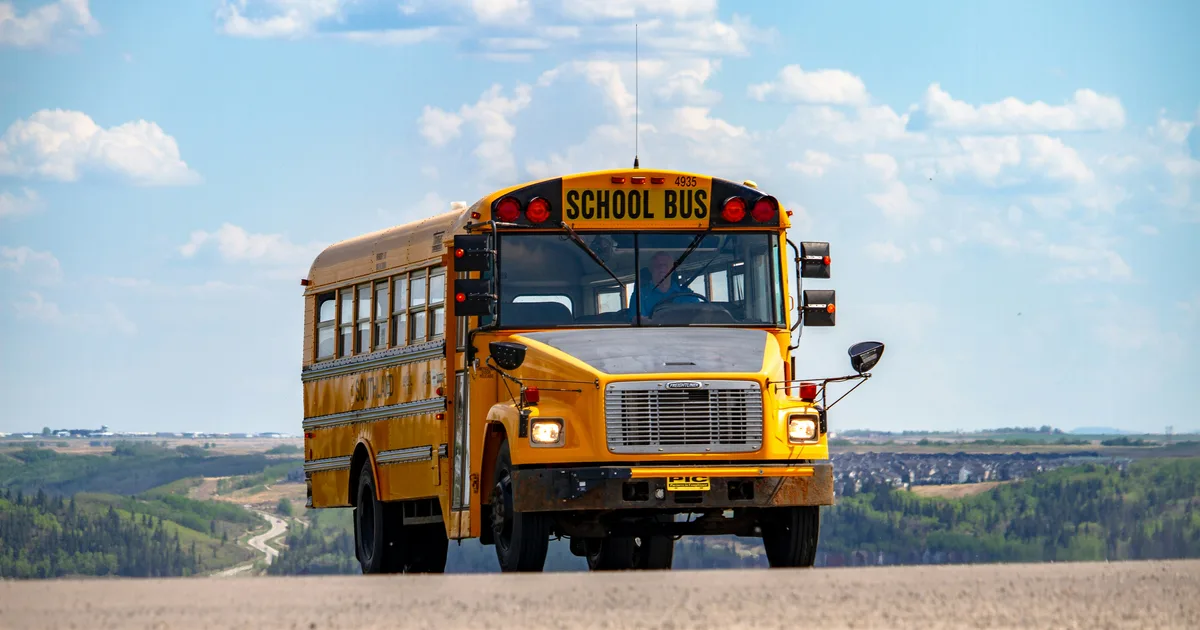
- Know what the lights mean. Flashing yellow lights mean the bus is preparing to stop to load or unload children, so slow down and prepare to stop. Flashing red lights and an extended stop arm mean the bus has stopped and children are getting on or off. Our school bus flashing lights guide covers each stage.
- Stop when the red lights flash. NHTSA notes that in every state it is illegal to pass a school bus while the stop arm is extended and the red lights are flashing. Whether traffic in the other direction must also stop depends on the road and the state; see when to stop for a school bus and divided highway rules.
- Leave room. Many states set a minimum stopping distance. Minnesota § 169.444 and Michigan MCL 257.682 both require you to stop at least 20 feet from a bus with its red lights flashing.
- Wait for all three signals. Do not move until the red lights stop flashing, the stop arm is withdrawn, and the bus begins moving. A bus driver waving you on is not a substitute for the lights going off unless your state's law says so.
- Look again after the bus leaves. Children who just got off may still be crossing, and children late for the bus may run toward it. NHTSA warns that late children "may dart into the street without looking for traffic."
- Slow down near stops, not just near schools. Bus stops are spread through neighborhoods and along rural roads, often far from any school zone sign. Watch for children waiting, walking or playing near a stop.
- Do not pass a bus that is slowing. Speeding up to get around a bus with flashing yellow lights puts you beside it right as the red lights come on and children step out.
- Put the phone away. Some states ban hand held phone use in school zones; see phone use in school zones. Near bus stops, the few seconds you look down are the seconds a child can cross.
- Back out slowly. More on driveways below.
How common is illegal passing of school buses?
Very common. Every year the National Association of State Directors of Pupil Transportation Services (NASDPTS) asks school bus drivers to count, on a single day, every vehicle that passes their stopped bus illegally. In its fourteenth survey, released July 21, 2026, 101,334 drivers in 39 states and the District of Columbia reported 56,024 illegal passes during the 2025 to 2026 school year. That was about 26.2% of the nation's school bus drivers.
NASDPTS scales the sample up to every school bus driver in the country and estimates just over 213,800 illegal passes each day. Over a 180 day school year, that projects to more than 38.4 million violations.
| Survey year | School year | Projected illegal passes per year |
|---|---|---|
| 2024 | 2023 to 2024 | 45.2 million |
| 2025 | 2024 to 2025 | 39.3 million |
| 2026 | 2025 to 2026 | 38.4 million |
The trend is moving down, and NASDPTS credits states that have raised penalties, authorized camera evidence or taken other steps. Its president still called 38.4 million passes "entirely too many." Several states now allow cameras mounted on the bus to catch drivers who pass; see school bus stop arm cameras and, for what a ticket costs, school bus passing fines.
What the crash data shows
School buses are among the safest ways for children to travel, and NHTSA calls them the most regulated vehicles on the road. The risk is concentrated outside the bus and in the vehicles around it. NHTSA's 2015 to 2024 fact sheet on school transportation crashes, published in July 2026, found:
- 1,069 people killed in 962 fatal school transportation related crashes over 10 years, an average of 107 a year.
- Most of those killed (70%) were occupants of other vehicles. Pedestrians were 15%, people on the school bus 11%, and other nonoccupants 4%.
- 162 pedestrians killed, compared with 119 school transportation vehicle occupants. Of the pedestrians, 117 were struck by school transportation vehicles and 45 by other vehicles.
- 204 school age children died in these crashes, including 77 pedestrians. Over half (55%) of those child pedestrians were 5 to 10 years old.
- 66% of school age pedestrians killed were hit away from an intersection, which fits the pattern of children crossing at bus stops in the middle of a block.
Most of the child pedestrians (57%) were struck by school buses or vehicles used as school buses, often as the bus was going straight or starting up from a stop. The rest were hit by other vehicles, including 3 who were struck by a vehicle passing or overtaking another vehicle. That is the part ordinary drivers control.
Morning and afternoon: when children are most at risk
NHTSA's table of school age deaths by time of day shows two clear peaks that match bus routes.
| Time of day | School age pedestrians killed | All school age deaths |
|---|---|---|
| 6:00 a.m. to 6:59 a.m. | 14 | 28 |
| 7:00 a.m. to 7:59 a.m. | 20 | 45 |
| 8:00 a.m. to 8:59 a.m. | 2 | 10 |
| 2:00 p.m. to 2:59 p.m. | 4 | 13 |
| 3:00 p.m. to 3:59 p.m. | 19 | 50 |
| 4:00 p.m. to 4:59 p.m. | 10 | 25 |
Source: NHTSA, School Transportation Related Traffic Crashes: 2015 to 2024 Data, Table 4. Other hours had 4 or fewer school age deaths each.
Morning
The 6 a.m. and 7 a.m. hours together account for 34 of the 77 school age pedestrian deaths. Early routes often run in low light, and children may be waiting in dark clothing on roads without sidewalks. Use your headlights, scan the roadside ahead, and treat every stopped vehicle with flashing lights as a bus until you can see otherwise.
Afternoon
The 3 p.m. hour is the single deadliest hour for school age children overall, with 50 deaths. In the afternoon, children are getting off the bus rather than getting on, so they come out of the danger zone and head toward home, sometimes across the road. Expect children on the far side of the bus to cross in front of it once the bus driver signals them.
Backing out of driveways near bus stops
NHTSA's long standing back to school advice for motorists starts at home: when backing out of a driveway or leaving a garage, watch out for children walking or bicycling to school. If your driveway is on a bus route or near a stop, the busiest moments for your street are the same minutes you are leaving for work.
- Walk around the car before you get in if children walk past your house in the morning.
- Back out slowly, and stop at the sidewalk line before you roll into the street.
- Do not rely only on a backup camera. Look over your shoulder, because a running child moves into the camera's view faster than you react.
- If a bus is stopped near your driveway with its red lights flashing, wait. Backing into the street beside it puts you in the same spot as a driver passing it.
Where bus stops and school zones overlap
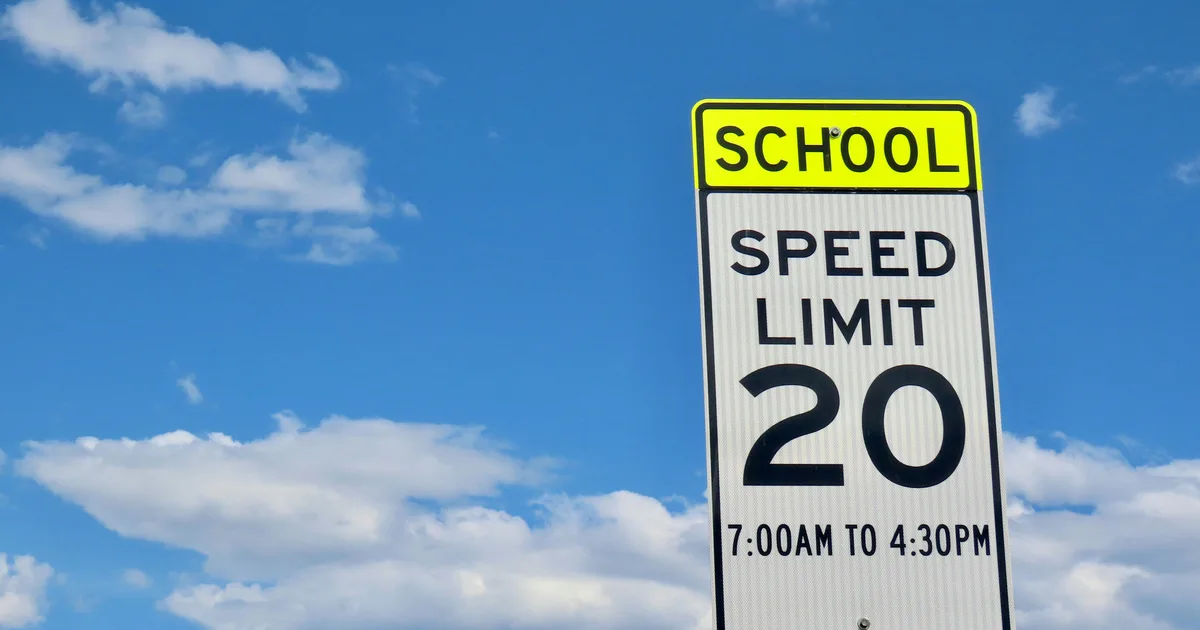
On streets near schools, you can meet a school zone and a bus stop in the same block. During school zone hours, the reduced limit is usually 15 to 25 mph, and fines often go up; see school zone speed limits by state, school zone hours and how much a school zone ticket costs.
The buses themselves have their own speed rules, and in some states they are capped well below the posted limit, so expect to catch up to them. Our guide to school bus speed limits lists the verified state caps.
The habit that helps most is arriving at those blocks already slow. SchoolSlow warns you when you are speeding in a school zone, which is useful on routes where bus stops sit just inside or next to the zone and you need time to react to a stopping bus.
Frequently asked questions
What is the danger zone around a school bus?
It is the area right around the bus where children are hardest to see, usually described as about 10 feet around the bus. NHTSA tells children to stay ten feet from the curb while waiting and to cross at least ten feet in front of the bus, and never walk behind it.
What should drivers do when a school bus has yellow lights flashing?
Slow down and prepare to stop. Flashing yellow lights mean the bus is about to stop to load or unload children, and the red lights and stop arm come next.
How far away do you have to stop from a school bus?
It depends on the state. Minnesota and Michigan require you to stop at least 20 feet from a bus with flashing red lights. Check your state's rule in our guide on when to stop for a school bus.
When can you drive again after a school bus stops?
NHTSA says to wait until the red lights stop flashing, the stop arm is withdrawn and the bus begins moving. Even then, look for children who are still crossing or running to catch the bus.
How many drivers illegally pass school buses?
In the 2026 NASDPTS survey, school bus drivers reported 56,024 illegal passes in one day. NASDPTS projects that to more than 38.4 million violations over a full school year.
What time of day is most dangerous at bus stops?
NHTSA data for 2015 to 2024 shows the most school age pedestrian deaths from 7 a.m. to 7:59 a.m., followed closely by 3 p.m. to 3:59 p.m. The 6 a.m. and 4 p.m. hours are also high.
Are school buses safe for children?
Yes. NHTSA calls school buses the most regulated vehicles on the road and designs its standards to make them safer than passenger vehicles. Most of the risk is outside the bus, which is why driver behavior near stops matters so much.
Sources
- School Bus Safety, National Highway Traffic Safety Administration, accessed November 2026.
- Annual NASDPTS Survey Highlights Danger of Passing School Buses; Data Shows Further Reduction of Illegal Passing, National Association of State Directors of Pupil Transportation Services, July 21, 2026, accessed November 2026.
- School-Transportation-Related Traffic Crashes: 2015 to 2024 Data (DOT HS 813 819), NHTSA National Center for Statistics and Analysis, July 2026, accessed November 2026.
- Minnesota Statutes § 169.444, School bus; stopping and passing, Minnesota Office of the Revisor of Statutes, accessed November 2026.
- MCL 257.682, Stopping for school buses, Michigan Legislature, accessed November 2026.
- NHTSA Urges Motorists to Drive Safely Near School Zones and Bus Stops, National Highway Traffic Safety Administration, November 2, 2018, accessed November 2026.
- National Stop Arm Violations, National Association of State Directors of Pupil Transportation Services, accessed November 2026.
- School bus safety brochure for motorists, parents and children (DOT HS 808 423), National Highway Traffic Safety Administration, July 1996, via the National Transportation Library, accessed November 2026.